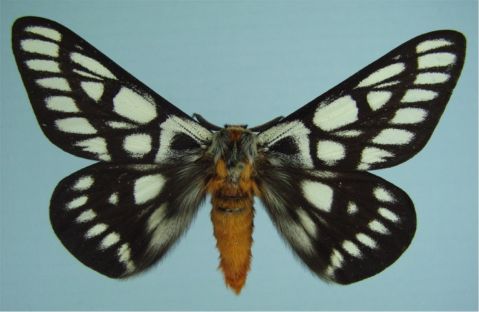
 |
Return to Texas Entomology - Compiled by Mike Quinn
|
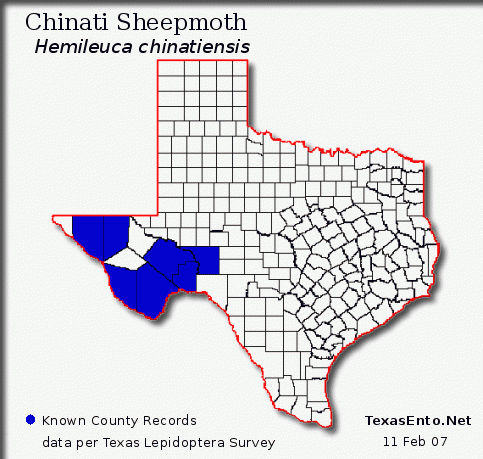 |
Hudspeth, Crockett, Culberson, Presidio, Brewster, Pecos, & Terrell Counties, Texas
Range:
Trans-Pecos of West Texas, plus Crockett Co., 28:x:1991 per Chris Durden.
In October 1980, Bowman (1985) collected 25 examples just south of Whites City, Eddy Co., New Mexico of a darker phenotype appeared to be H. chinatiensis.
Not reported as likely for adjacent Mexico (Tuskes et al. 1996).
Flight Period: Adults occur from September into November, mostly in late October.
Flight Time: Mainly late-morning to mid-afternoon. (11AM to 3PM).
Habitat: Occurs in shrubby desert areas.
Larval Host Plants: H. chinatiensis have a strong preference for flower buds over foliage. (Michael Van Buskirk, pers. comm)
Littleleaf Sumac - Rhus microphylla is the most commonly used foodplant - Tuske et al. (1996)
Larvae also feed on:
Mimosa lindheimeri, M. borealis, M. biuncifera - Family Fabaceae
Forestiera angustifolia - Family Oleaceae
Ephedra nevadensis aspera - Family Ephedraceae
Rhus aromatica flabelliformis, R. microphylla - Family Anacardiaceae
Mahonia trifoliata - Family Berberidaceae
Krameria parviflora - Family Krameriaceae
Type Locality: Shafter, Chinati Mountains, Texas.
Conservation Status: Although limited in range, this species can be locally common some years.
Global Status: G3 - Vulnerable - NatureServe
Similar Species:
The genus Hemileuca consists of 23 described species, 16 of which have partial or complete distributional patterns north of Mexico. (Tuskes, 1978).
Texas Taxa: per Texas Lepidoptera Survey:
Hemileuca maia maia
Hemileuca m. peigleri
Hemileuca m. nr. peigleri (probably a new ssp.)
Hemileuca juno
Hemileuca slosseri
Hemileuca grotei
Hemileuca hera marcata(?)
Hemileuca chinatiensis
Hemileuca oliviae
Weblinks: Chinati sheepmoth - NBII
Bibliography: Dr. Ernest R. Tinkham
References:
Bowman, D.E. 1985. A range extension and dark phenotype of Hemileuca chinatiensis. Journal of Research on the Lepidoptera 24: 85.
Ferguson, D.C. 1971. Bombycoidea: Saturnidae, Citheroniinae and Hemileucinae. Part I. Moths of America North of Mexico, Fascicle 20.2B. E.W. Classey Ltd. and R.B.D. Publications, London, England.
Kendall, R.O. & R.S. Peigler. 1981. Hemileuca grotei (Saturniidae): its morphology, natural history, spatial and temporal distribution. Journal of the Lepidopterists' Society, 35(1): 41-50.
Knudson, E. & C. Bordelon. 1999. Checklist of the Lepidoptera of the Guadalupe Mountains National Park. Texas Lepidoptera Survey #4, 82 pp.
Lemaire, C. 1988. The Saturniidae of America. Ceratocampinae. Museo Nacional Costa Rica, San Jose, 480 pp., 64 plates.
McElfresh, S.J., A.M. Hammond & J.G. Millar. 2004. Sex Pheromone Components of the Buck Moth Hemileuca maia. Journal of Chemical Ecology, 27(7): 1409-1422. [abstract]
McElfresh, J.S., Millar, J.G. 1999. Sex pheromone of the common sheep moth,
Hemileuca eglanterina, from the San Gabriel mountains of southern
McElfresh, J.S., J.G. Millar. 1999. Sex pheromone of Nuttall's sheep moth,
Hemileuca nuttali, from the eastern Sierra Nevada mountains of
McElfresh, J.S., J.G. Millar. 1999. Geographic variation in the sex pheromone
blend of Hemileuca electra from southern
Peigler, R.S. 1985. Description, distribution, and biology of a new Hemileuca (Lepidoptera: Saturniidae) from western Texas and southern New Mexico. Nachrichten des Entomologischen Vereins Apollo (Frankfurt) 6(2): 113-124.
Peigler, R.S. 1993. Wild silks of the world. American Entomologist, 39(3): 151-161.
Peigler, R.S. 1996. Catalog of parasitoids of Saturniidae of the world. The Journal of Research on the Lepidoptera, 33: 1-121.
Peigler, R.S. & P. Opler. 1993. Moths of Western North America, 1. Distribution of Saturniidae of North America. Contributions of the C.P. Gillette Insect Biodiversity Museum Department of Entomology, Colorado State University.
Peigler, R.S. & S.E. Stone. 1989. Taxonomic and biological notes on the Hemileuca maia complex (Saturniidae) with description of a new species from Texas and New Mexico. Transactions of the Lepidopterological Society of Japan, 40(2): 149-166.
Pryor, G.S. 1998. Life history of the bog buck moth (Saturniidae: Hemileuca) in the New York state. Journal of the Lepidopterists' Society, 52(2): 125-138.
Rubinoff, D. Field observations on mating behavior and predation of Hemileuca electra (Saturniidae). Journal of the Lepidopterists’ Society, 52(2): 212-214.
Tinkham, E.R. 1944. Faunistic notes on the diurnal Lepidoptera of the Big Bend Region of Trans-Pecos Texas, with the description of a new Melitaea. The Canadian Entomologist 76(1):11-18.
Tuskes, P.M. 1978. A new species of Hemileuca from the southwestern United States (Saturniidae). Journal of the Lepidopterists' Society 32(2): 97-102.
Tuskes, P.M. 1984. The biology and distribution of California Hemileucinae (Saturniidae). Journal of the Lepidopterists' Society 38(4): 281-309.
Tuskes, P.M. 1986. Biology and immature stages of Hemileuca diana and H. grotei (Saturniidae). Journal of the Lepidopterists' Society, 40(1): 27-35.
Tuskes P.M., & S. McElfresh. 1995. The biology and distribution of Hemileuca electra populations in the United States and Mexico, with description of two new subspecies. Journal of the Lepidopterists' Society, 49(1): 49-71.
Tuskes, P.M., J.P. Tuttle & M.M.Collins. 1996. The Wild Silk Moths of North America. A natural history of the Saturniidae of the United States and Canada. Cornell University Press, Ithaca, New York. 250 pp.
26 Aug 2007 © Mike Quinn / mike.quinn@tpwd.state.tx.us / Texas Entomology / Texas Lep Information